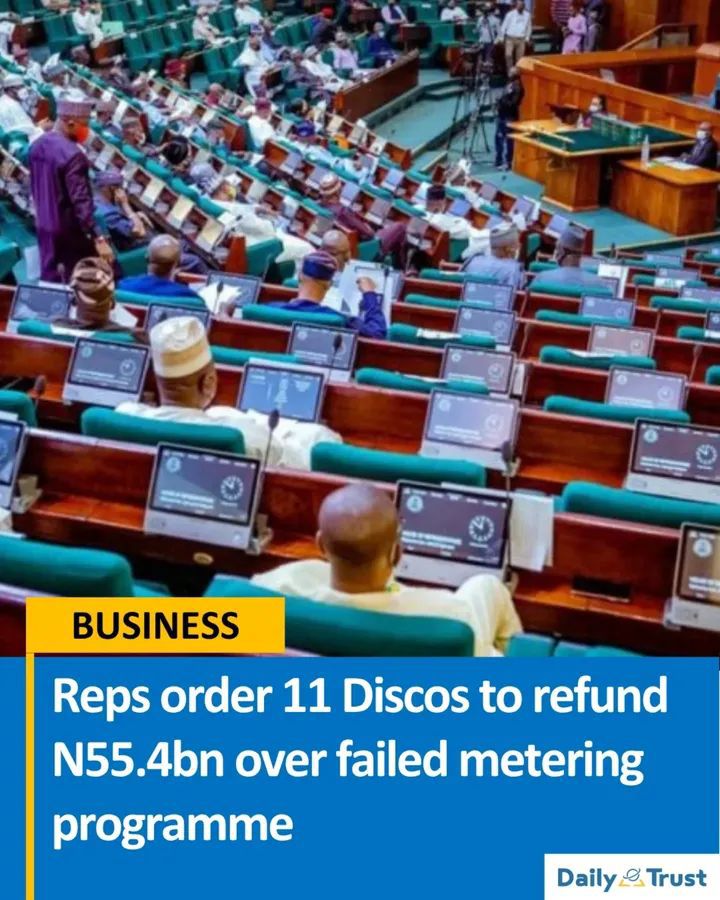
The House of Representatives has directed 11 electricity distribution companies (DISCOs) to refund N55.42 billion disbursed under the National Mass Metering Programme (NMMP), citing inefficiencies and failure to meet expected targets.
The resolution followed the adoption of a report presented by the House Committee on Public Assets, which revealed that the DISCOs received the funds as loans with a nine per cent interest rate. The committee noted that the programme fell short of expectations in closing the metering gap and addressing billing inefficiencies.
The NMMP was introduced in 2020 to bridge Nigeria’s metering deficit, eliminate estimated billing, reduce commercial losses, and promote local manufacturing of meters. However, findings showed that the DISCOs received N55.42 billion, leaving N3.85 billion unaccounted for.
The House has mandated the Central Bank of Nigeria (CBN) and the Nigerian Electricity Regulatory Commission (NERC) to establish a loan recovery committee tasked with recovering the funds from beneficiary DISCOs before 2026.
Beneficiaries of the scheme include Abuja, Eko, Enugu, Ibadan, Ikeja, Jos, Kano, and Yola electricity distribution companies, among others. The committee raised concerns over the programme’s overall impact, noting that it fell short of expectations.
The committee also scrutinised the role of Meristem Wealth Management, which was granted a clause entitling it to 0.5 per cent of DISCO collections annually until 2030. The firm had already received N450 million, a development the committee described as questionable.
The House Committee on Public Assets has requested detailed documentation from Meristem Wealth Management, including its operational structure and performance report under the NMMP.
The investigation revealed significant gaps in the implementation of the metering initiative, with the committee chairman stating that the investigation was conducted in line with the committee’s oversight mandate.
The NMMP was designed to be implemented in three phases, with the CBN commencing with N59.28 billion for procurement and installation of one million meters in 2020 at an interest rate of nine per cent after a two-year moratorium.
The House of Representatives has begun investigation into the NMMP, with a 19-member committee inaugurated to probe the disbursement and utilisation of the N200 billion CBN loan.
Would you like to know more about the implications of this decision on the power sector or the potential impact on electricity consumers?
About The Author