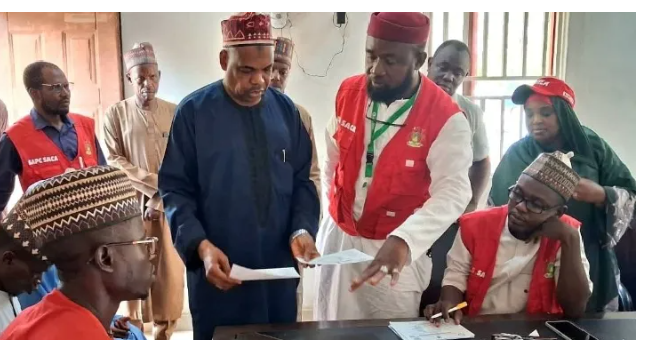
Barely one year after the appointment of the board of the North-West Development Commission (NWDC), the commission is yet to find its footing, as the joint committee of the National Assembly’s interaction with the MD/CEO, Professor Shehu Abdullahi Ma’aji, on Wednesday, December 17, 2025, revealed the root cause of why the agency has continued to struggle despite its strategic nature in Nigeria.
While addressing the joint committee of the Senate and House of Representatives on NWDC, chaired by Senator Babangida Hussaini and co-chaired by Hon. Dr. Sulaiman Abubakar Gumi, Prof. Ma’aji lamented that the chairman of the board, Alhaji Lawal Sama’ila Abdullahi, has not only undermined his office but has also assumed his position, because he has deliberately refused to see himself as a part-time chairman of the board, but rather as an executive chairman, which is contradicting the act that established the commission.
He therefore called on the commission to intervene to save the commission and allow its takeoff in earnest.
“My biggest problem is that the chairman of the board, Alhaji Lawal Sama’ila Abdullahi, sees himself as the executive chairman of the commission. At least, for the last four board meetings we’ve held, he doesn’t see me as the MD/CEO, rather as a board member, which he chaired. He has been going about with one of the board members, occupying my space, and that has stalled the development of the agency, so I want clarification here.”
In a swift reaction, the Senate Committee Chairman on NWDC, Sen. Babangida Hussaini, explained that, from the act establishing the commission, the board chairman is a part-time chairman and not an executive chairman, therefore urging Alhaji Lawal Sama’ila Abdullahi to take note and work accordingly.
Meanwhile, the joint committee delivered one of its toughest oversight messages yet, warning that patience is thinning as Nigeria’s newest regional intervention agency struggles to translate promise into visible impact across a region burdened by poverty, insecurity, and demographic pressure.
Members of the joint committee, at the intense interactive session, praised the vision behind the creation of the six new regional development commissions by President Bola Ahmed Tinubu but expressed growing concern that the North-West Commission is lagging dangerously behind its peers.
Committee members noted that while other commissions, particularly in the South-West, have moved swiftly from legislation to action, the NWDC remains largely defined by media appearances, internal disagreements, and delayed appointments, rather than projects on the ground.
“We did not create this commission for press statements and social media visibility,” the lawmakers warned. “We created it to solve problems.”
Lawmakers reminded the commission’s leadership that the North-West accounts for nearly a quarter of Nigeria’s population, over 52 million people, yet carries a disproportionate share of the country’s development crises: out-of-school children, banditry, kidnapping, drug abuse, climate stress, arms proliferation, and urban crime.
“These challenges are not abstract,” the committee said. “They are daily realities. That is why this commission matters more here than anywhere else.”
Against this backdrop, committee members expressed disappointment that nearly a year after takeoff, the commission is still struggling with executive appointments, weak stakeholder engagement, and unresolved governance tensions between the board and management.
The Chairman of the Joint Committee, Sen. Husseini, revealed that the committee had already intervened to resolve internal frictions between the board and management, stressing that this session marked the final attempt at mediation.
“This is the last time we will sit here to resolve internal disputes,” the chairman said pointedly. “We have voted, we have cleared the commission, and we expect you to move forward.”
Lawmakers also raised concerns about the commission’s limited engagement with State Governors, Corporate Nigeria, Development Partners, and Donor Institutions beyond initial courtesy visits.
“The Assembly has given you latitude to innovate, raise funds, and generate ideas,” the committee said. “But latitude without delivery is wasted space.”
One of the strongest messages from the Senate was the call for the NWDC to break free from total dependence on Federal allocations. Lawmakers urged the commission to convene a large-scale regional summit, bringing together technical colleges, private sector players, and development partners to design sustainable funding and investment models.
“The era of waiting for government releases alone is over,” a lawmaker said. “If funding stalls tomorrow, what is your Plan B?
Responding, the Managing Director of the NWDC presented a progress report covering January to December 2025, describing the commission as still in its foundational phase after being established by law in 2024.
He outlined the commission’s operational scope: seven states, 186 local governments, over 2,000 wards, and confirmed a regional population estimate of about 54 million people.
According to the MD, the commission has focused on institutional groundwork:
– Courtesy and alignment visits to all seven state governors
– Participation in national retreats and development conferences
– Development of an organizational structure, corporate identity, website, and social media platforms
– Engagements with international partners, including the World Bank, AfDB, IsDB, UNDP, JICA, GIZ, and the UK’s FCDO
He also unveiled ambitious conceptual initiatives, including proposals for a North-West Investment Company, Power Company, Transport Company, Commodity Exchange, Water Projects, and Centres of Excellence.
On finances, the MD disclosed that the commission received an appropriation of about ₦145.6 billion, allocated as follows:
– Personnel: 5%
– Overhead: 20%
– Capital projects: 75%
Sectoral allocations include security (22%), agriculture (17%), education (15%), infrastructure (14%), health (13%), youth and women empowerment (11%), ecology (5%), and mining (3%).
Security will dominate the 2026 budget, in line with presidential directives, with funding earmarked for equipment for law enforcement, community security initiatives, rehabilitation of displaced persons, and grassroots intelligence systems.
Agriculture plans focus on empowering large, medium, and cooperative-based small-scale farmers with mechanisation, inputs, and logistics to boost food security.
The MD admitted that no staff recruitment has taken place due to pending waivers, but said approval from the Head of Service was imminent. He also announced a major North-West Stakeholders’ Summit, fully funded by UK Aid, to be held in phases starting January in Kaduna, aimed at producing a regional master plan.
Temporary headquarters have been secured in Kano, pending permanent facilities.
While acknowledging the groundwork laid so far, senators made it clear that the commission has exhausted its grace period.
“We have heard your plans,” the Vice-Chairman said. “Now we want to see execution. One year of preparation, funded or not, should produce results.”
The message from the Senate was unmistakable: the North-West Development Commission must move from frameworks to factories, from meetings to measurable outcomes, or face intensified legislative scrutiny in the months ahead.
About The Author