By Editor Mahmoud Muhammad
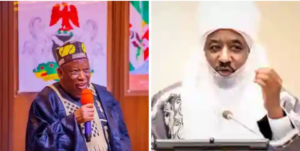
Former Kano State Governor, Dr. Abdullahi Umar Ganduje, has clarified that only the Supreme Court of Nigeria can determine the fate of Muhammadu Sanusi II in the ongoing emirship dispute. Ganduje made this statement while reacting to reports alleging that he had endorsed Sanusi as Emir of Kano and Chairman of the Kano State Council of Chiefs.
Ganduje described the reports as a misinterpretation, saying his reference to Sanusi by his traditional title during the swearing-in ceremony of the Deputy Governor was merely a matter of courtesy and protocol. “It is important to clarify that what happened was simply an expression of respect in a public gathering. It should not be misconstrued as an endorsement,” he said.
The former Governor stressed that the emirship tussle remains sub judice, cautioning that public commentary must be handled carefully to avoid actions that could amount to contempt of court. He recalled that the Court of Appeal had earlier directed all parties to maintain the status quo pending the final determination of the case.
Ganduje emphasized that as a former governor, he has no constitutional authority to endorse or reject any claimant to the emirship, noting that the matter rests entirely with the judiciary and subsequently with the state government.
The current legal position recognizes Aminu Ado Bayero as the 15th Emir of Kano and Muhammadu Sanusi II as the 14th Emir, pending the final judgment of the Supreme Court. Ganduje urged all parties to exercise restraint and await the Supreme Court judgment, expected in April 2027.
Ganduje’s clarification comes after he publicly referred to Sanusi as Emir of Kano during the swearing-in ceremony of the new Deputy Governor, Murtala Sule Garo. The gesture was seen as a significant development in the long-standing emirship dispute.
The Kano Emirship dispute has drawn widespread attention, with rival claims to the throne generating political and legal tensions in the state. The Supreme Court is expected to deliver a final judgment on the matter. ⁸
Ganduje’s statement reflects the delicate balance between traditional institutions and legal authority in Nigeria, where chieftaincy disputes often intersect with politics and governance.
Would you like to know more about the implications of Ganduje’s statement or the history behind the Kano Emirship dispute?
About The Author