Editor -in-Chief
Twenty years ago, when the Sharia crisis escalated in Kaduna and led to killings and maiming, many were optimistic that southern newspapers had triggered the war between Muslims and Christians.
That narrative shaped how the North viewed the media for years — as an outsider, a provocateur, and sometimes an enemy of regional peace.
Today, history appears to be repeating itself, but this time the divide is not religious. It is political. Northerners are openly at war with President Bola Ahmed Tinubu’s administration.
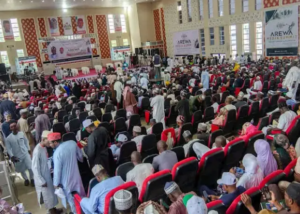
In response to this growing tension, the President’s Media Aide, Abdulazeez Abdulazeez, organized an Arewa Media Summit as a watchdog platform to deliberate on the way forward for media engagement in the region.
The summit was billed as a unifying forum where northern media stakeholders would strategize on how to project the region’s interests and manage its relationship with the federal government.
However, the meeting recorded a very poor turnout and raised questions about the level of trust and coordination between the Presidency and northern states.
Only a handful of states participated. Kano served as host, while Kebbi, Kaduna, and Yobe were also represented at the summit.
Notably absent were Jigawa, Katsina, Bauchi, Gombe, Adamawa, Taraba, Niger, Nasarawa, Plateau, Zamfara, Kogi, and Sokoto.
The absence of more than 13 northern states signaled a deep disconnect and possible boycott of an initiative seen as coming directly from the Villa.
Political observers say the empty seats at the summit reflect the current mood in the North — frustration, alienation, and a feeling of being sidelined by the Tinubu administration.
11. Unlike 20 years ago when the media was accused of fueling religious conflict, this time the media is being called upon to manage a political crisis between the region and the center.
Abdulazeez Abdulazeez, in his remarks, stressed the need for northern media to act as watchdogs, not attack dogs, and to promote issue-based engagement rather than confrontation.
He argued that the region must speak with one voice and use the media to negotiate better for its share of federal projects, appointments, and policies.
But many delegates who stayed away believe the summit came too late and lacked sincerity, given ongoing grievances over appointments, economic policies, and security strategy.
For states like Katsina, Zamfara, and Sokoto that are battling severe insecurity, the absence may also reflect a prioritization of local crises over Abuja-organized dialogues.
Others from Bauchi, Gombe, and Adamawa are believed to be aligning with opposition voices and may not want to be seen at a pro-Presidency media gathering.
The irony is not lost on many: two decades ago, southern papers were blamed for dividing the North. Today, northern leaders themselves appear divided on how to engage with the North’s own media strategy.
The Kano host government tried to give the summit legitimacy, but without the weight of a full northern consensus, its resolutions may carry little authority.
Media practitioners present at the summit deliberated on fact-checking, countering fake news, and telling “the northern story” from a northern perspective.
They also discussed how to protect journalists covering banditry, protests, and political rallies without being labeled as enemies of government.
Yet without the participation of major northern states, the summit’s recommendations risk being dismissed as a Abuja project rather than an Arewa project.
The poor attendance may force the Presidency to rethink its media and political outreach to the North ahead of 2027.
For now, the Arewa Media Summit has exposed one hard truth: the North is not only debating Tinubu’s policies, it is also debating whether it still speaks with one voice at all.
About The Author