By Editor
The Jigawa State Government is set to establish standard Tsangaya schools across the state to enrol 4,500 Almajiris, as part of efforts to discourage street begging and the movement of Almajirai around markets and major towns.
The initiative is also aimed at reforming the traditional Tsangaya education system and integrating Almajirai into a structured learning environment that will provide them with better living and learning conditions.
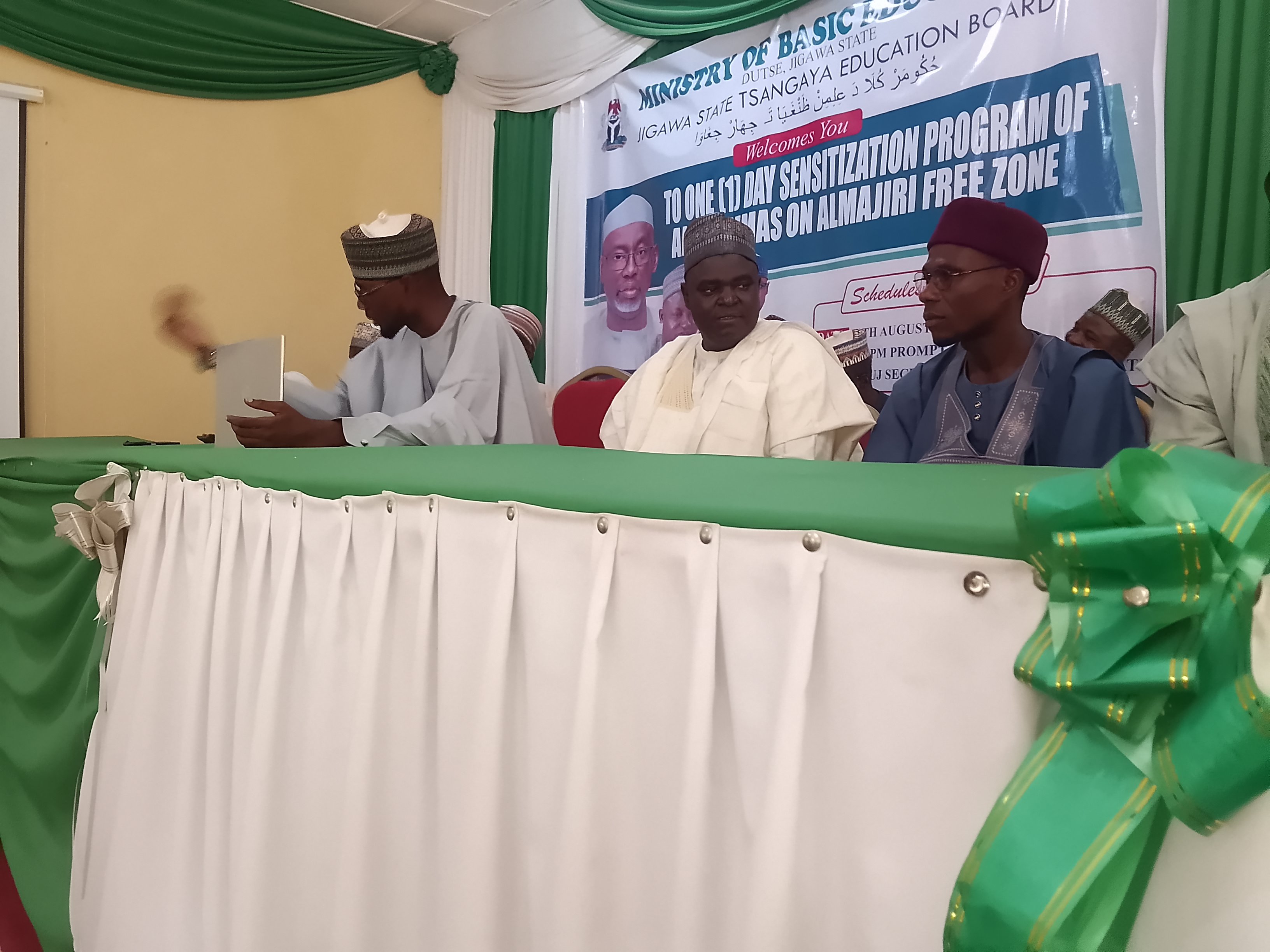
The Executive Secretary of the Jigawa State Tsangaya Education Board, Dr Abubakar Majeri Hamisu, disclosed this in a speech delivered during a meeting with 150 Alarammomi (Tsangaya teachers) selected from across the state. The meeting was held at the conference hall of the Jigawa State Council of the Nigeria Union of Journalists (NUJ).
He said the state government would construct 27 new Tsangaya schools across the state, adding that preparations were already at an advanced stage for the construction of 10 of the schools this year.
According to him, the government has selected 10 local government areas where the first phase of the project will commence.
Explaining the purpose of the meeting with the 150 Alarammomi, Dr Hamisu said it was organised to discuss ways of transitioning Almajirai from street-based learning to a more organised school system.
He said the government would provide the schools with facilities similar to those available in conventional schools, including accommodation and other basic amenities, to improve the welfare of the Almajirai.
He added that the government would introduce a programme to improve the conditions of Tsangaya schools that are not directly under its management by providing solar-powered lighting systems to schools across the state.
The government, he further disclosed, would provide fertiliser and other agricultural inputs to Alarammomi and integrate them into farming programmes. The initiative, he said, would enable them to produce food to support the feeding of Almajirai under their care and reduce dependence on street begging.
Dr Hamisu said the measures were part of the state government’s broader efforts to improve the welfare and standard of Tsangaya schools across Jigawa.
He, however, warned Alarammomi against travelling to other states to bring additional Almajirai into their schools, saying such practice would be contrary to the government’s new policy.
He assured the teachers that some of the new Tsangaya schools would employ qualified Alarammomi as teachers, while others would be enrolled in a government support scheme under which they would receive monthly allowances to improve their welfare and enable them to concentrate on their responsibilities.
He explained that the initiative was also designed to make Alarammomi more economically self-reliant, while equipping Almajirai with knowledge and skills that would enable them to become self-sufficient after completing their studies.
Under the new system, he said, students would receive instruction in Qur’anic studies, English and mathematics, as well as vocational skills that would prepare them for independent livelihoods after graduation.
Dr Hamisu said the government planned to enrol 4,500 Almajirai under the programme.
He explained that 1,000 students would be enrolled in Kafin Hausa, another 1,000 in Dutse and 1,000 in Ringim, while the remaining 1,500 would be admitted into Tsangaya schools in other parts of the state.
He said the ultimate objective of the programme was to curb street begging by Almajirai and provide them with access to structured education, accommodation, vocational training and improved welfare across Jigawa State
About The Author